

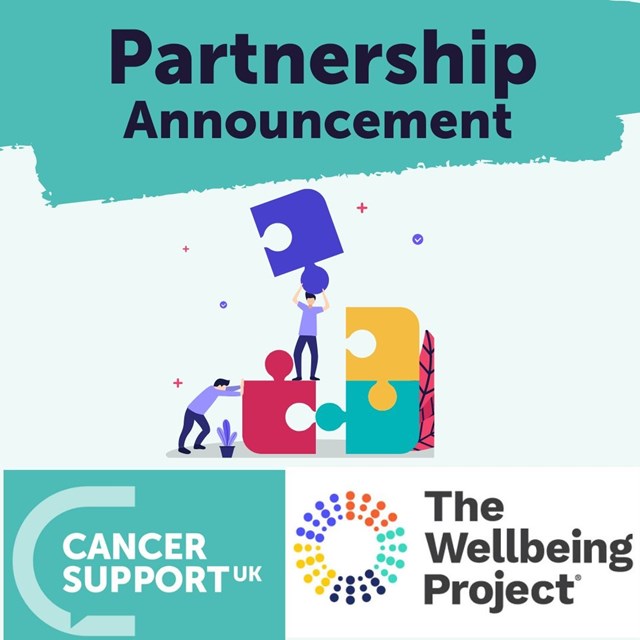
Cancer Support UK is delighted to announce its new partnership with global wellbeing consultancy The Wellbeing Project, which has been instrumental in creating healthy workplace cultures for over 15 years.
With almost one million people of working age diagnosed with cancer, organisations increasingly need to be prepared to support those impacted whether directly or indirectly.
The Wellbeing Project’s extensive experience in providing sustainable organisational wellbeing solutions makes them ideally placed to raise awareness of Cancer Support UK’s innovative Workplace Cancer Support Ambassador training programme.
The Workplace Cancer Support Ambassador training provides a high-level introduction to cancer and cancer treatments and gives individuals in organisations the confidence and skills to support colleagues facing cancer.
Commenting on the new partnership, Mark Guymer, Cancer Support UK’s CEO, said:
It is absolutely key to have a deep understanding of human behaviour when working with people living with and beyond cancer. As a cancer charity, we are experts in communicating about cancer and we are confident that, in choosing The Wellbeing Project as our partner, we will have a trusted and knowledgeable ally, who shares our commitment to delivering wellbeing solutions for businesses and their people.
Mark Guymer, Cancer Support UK’s CEO
With at least 85% of employees saying how important it is for them to keep working after a cancer diagnosis, there is an urgent requirement for employers to understand the needs of colleagues affected by cancer and to support them appropriately.
The half day Workplace Cancer Support Ambassador course addresses how to meet those needs. It explores both the physical and emotional side effects of cancer and cancer treatments and provides the necessary skills to have supportive conversations with individuals impacted by cancer. It also supports the Ambassadors themselves to prioritise their own wellbeing as they support others.
The Wellbeing Project said:
We are looking forward to working with Cancer Support UK to deliver the Workplace Cancer Support Ambassador Training. This pioneering programme is based on a solid foundation of people’s actual lived experience, and we believe it has a vital role to play in creating workplaces where those who are facing cancer feel fully supported.
The Wellbeing Project
In this video Mark Guymer, CEO of Cancer Support UK, focuses on the importance of talking about cancer in the workplace and the need to train people in organisations to support colleagues facing a cancer diagnosis. Please feel free to use this video.
For more information about the Workplace Cancer Support Ambassador training visit https://thewellbeingproject.co.uk/workplace-cancer-support-ambassador-training/

Joanne is the editor for Workplace Wellbeing Professional and has a keen interest in promoting the safety and wellbeing of the global workforce. After earning a bachelor's degree in English literature and media studies, she taught English in China and Vietnam for two years. Before joining Work Well Pro, Joanne worked as a marketing coordinator for luxury property, where her responsibilities included blog writing, photography, and video creation.
- Joanne Swann
- Joanne Swann
- Joanne Swann
- Joanne Swann
- Joanne Swann
- Joanne Swann
- Joanne Swann
- Joanne Swann
- Joanne Swann
- Joanne Swann
- Joanne Swann
- Joanne Swann
- Joanne Swann
- Joanne Swann
- Joanne Swann
- Joanne Swann
- Joanne Swann
- Joanne Swann
- Joanne Swann
- Joanne Swann
- Joanne Swann
- Joanne Swann
- Joanne Swann
- Joanne Swann
- Joanne Swann
- Joanne Swann
- Joanne Swann
- Joanne Swann
- Joanne Swann
- Joanne Swann
- Joanne Swann
- Joanne Swann
- Joanne Swann
- Joanne Swann
- Joanne Swann
- Joanne Swann
- Joanne Swann
- Joanne Swann
- Joanne Swann
- Joanne Swann
- Joanne Swann
- Joanne Swann
- Joanne Swann
- Joanne Swann
- Joanne Swann
- Joanne Swann
- Joanne Swann
- Joanne Swann
- Joanne Swann
- Joanne Swann
- Joanne Swann
- Joanne Swann
- Joanne Swann
- Joanne Swann
- Joanne Swann
- Joanne Swann
- Joanne Swann
- Joanne Swann
- Joanne Swann
- Joanne Swann
- Joanne Swann
- Joanne Swann
- Joanne Swann
- Joanne Swann
- Joanne Swann
- Joanne Swann
- Joanne Swann
- Joanne Swann
- Joanne Swann
- Joanne Swann
- Joanne Swann
- Joanne Swann
- Joanne Swann
- Joanne Swann
- Joanne Swann
- Joanne Swann
- Joanne Swann
- Joanne Swann
- Joanne Swann
- Joanne Swann
- Joanne Swann
- Joanne Swann
- Joanne Swann
- Joanne Swann
- Joanne Swann
- Joanne Swann
- Joanne Swann
- Joanne Swann
- Joanne Swann
- Joanne Swann
- Joanne Swann
- Joanne Swann
- Joanne Swann
- Joanne Swann
- Joanne Swann
- Joanne Swann
- Joanne Swann
- Joanne Swann
- Joanne Swann
- Joanne Swann
- Joanne Swann
- Joanne Swann
- Joanne Swann
- Joanne Swann
- Joanne Swann
- Joanne Swann
- Joanne Swann
- Joanne Swann
- Joanne Swann
- Joanne Swann
- Joanne Swann
- Joanne Swann
- Joanne Swann
- Joanne Swann
- Joanne Swann
- Joanne Swann
- Joanne Swann
- Joanne Swann
- Joanne Swann
- Joanne Swann
- Joanne Swann
- Joanne Swann
- Joanne Swann
- Joanne Swann
- Joanne Swann
- Joanne Swann
- Joanne Swann
- Joanne Swann
- Joanne Swann
- Joanne Swann
- Joanne Swann
- Joanne Swann
- Joanne Swann
- Joanne Swann
- Joanne Swann
- Joanne Swann
- Joanne Swann
- Joanne Swann
- Joanne Swann
- Joanne Swann
- Joanne Swann
- Joanne Swann
- Joanne Swann
- Joanne Swann
- Joanne Swann
- Joanne Swann
- Joanne Swann
- Joanne Swann
- Joanne Swann
- Joanne Swann
- Joanne Swann
- Joanne Swann
- Joanne Swann
- Joanne Swann
- Joanne Swann
- Joanne Swann
- Joanne Swann
- Joanne Swann
- Joanne Swann
- Joanne Swann
- Joanne Swann
- Joanne Swann
- Joanne Swann
- Joanne Swann
- Joanne Swann
- Joanne Swann
- Joanne Swann
- Joanne Swann
- Joanne Swann
- Joanne Swann
- Joanne Swann
- Joanne Swann
- Joanne Swann
- Joanne Swann
- Joanne Swann
- Joanne Swann
- Joanne Swann
- Joanne Swann
- Joanne Swann
- Joanne Swann